
Find your light
Handcrafted luminaires for exceptional spaces.
A handcrafted lighting piece should spark joy. For the creative who sees an artistic idea come to life, for the maker who manipulates raw materials into a tangible form, and for the client who receives a unique and enduring design.
The process of making this design come to life in the studio and in the workshop is more complex than it may seem. In our world of custom light fittings and artworks, taking a piece from concept to reality requires expertise across art, design and craft, along with the elements that are fundamental but often overlooked, such as engineering, electronics and fabrication.
At Nulty Bespoke, we continually refine our skills across these intertwining disciplines to elevate our practice. This is strengthened by a close relationship with our sister brand, Nulty, which allows us to understand form, scale and materials within the broader context of design, the mechanics of engineering and the science of light.
This is how we take a concept and carry it through to a fully realised, buildable outcome that balances design intent with technicality. Each stage is a process of iteration that involves developing, realising and refining the design to preserve the integrity of the original idea and ensure it performs as intended.
Design
A bespoke lighting commission begins with close engagement at the concept stage.
The exchange of ideas is a constant. Every piece is created in response to its context and evolves as we explore creative possibilities, make sense of the narrative and apply our design insight and specialist knowledge.
A narrative comes from the simple act of listening to a client’s personal requirements. Inspiration stems from almost any source – a personal memory, a brand reference, or an entirely abstract theme. At this stage, there are no constraints: any idea can be turned it into a custom luminaire with lasting appeal.
Realisation
Once the narrative is defined, our focus turns to realisation.
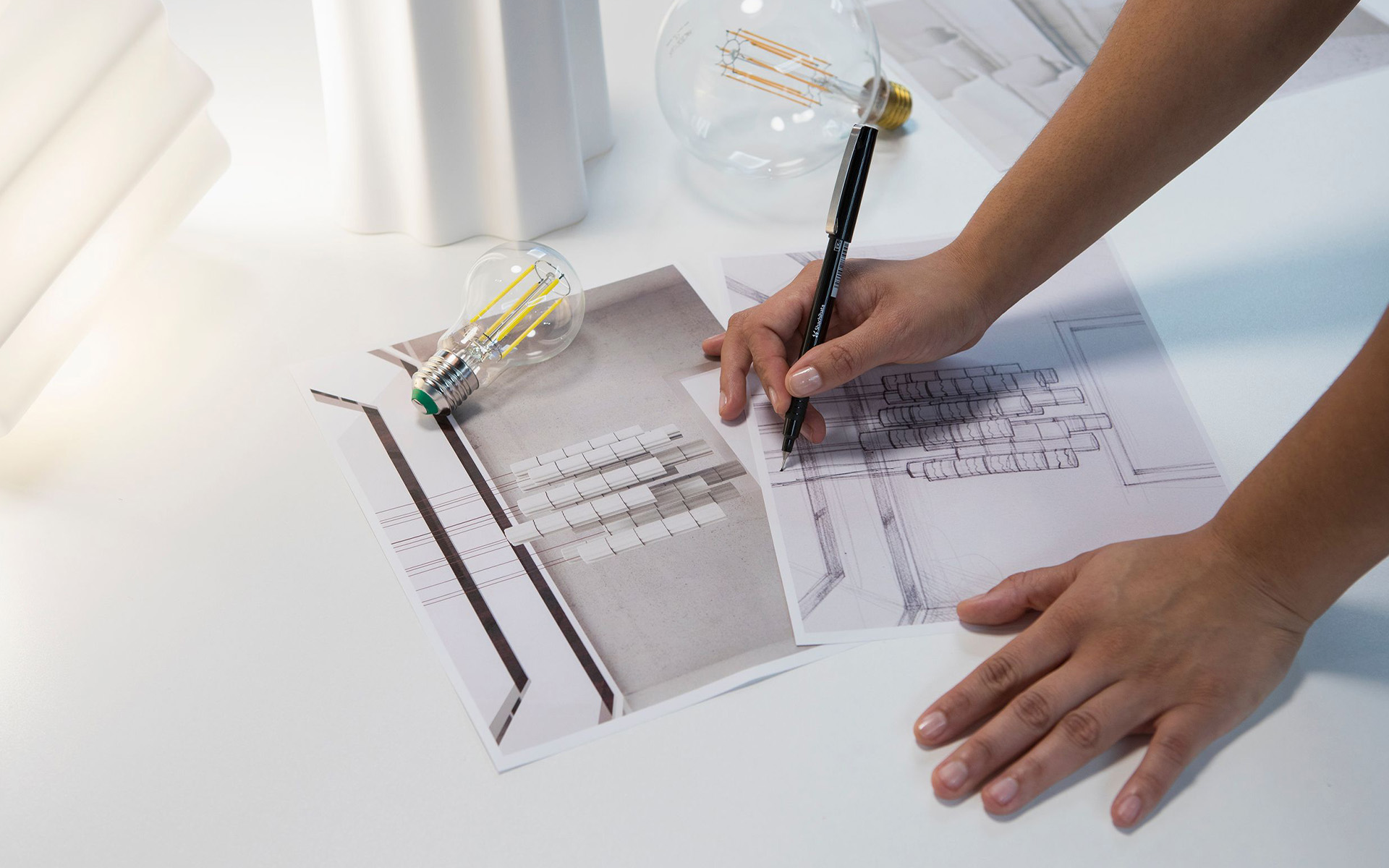
Across the studio, we are constantly perfecting this stage of the process. Sketches, renders and models allow us to bring concepts to life in a meaningful way, marrying architectural drawings with detailed visualisations of the luminaire, then placing them within a realistic environment that emulates the final scheme.
The process of translating concepts into tangible designs varies from studio to studio. While AI tools offer quick and compelling creative possibilities, they cannot yet realise a piece as intended. They may produce visualisations that look very polished and ‘real’, but the trained eye will detect glitches or inconsistencies in the form of skewed details, compositional flaws, and in some cases, design concepts that literally defy gravity.
This is where the art of human curation is essential. Informed by practical knowledge and steered by our experience, we finesse the details. Without this, there is a risk of promising something a beautiful that is difficult to deliver. We aim to bring as much physical integrity as possible to the concept at this stage, before moving into prototyping, where our ideas are developed in the real world.
Prototyping
Working with materials and light is innately experimental.
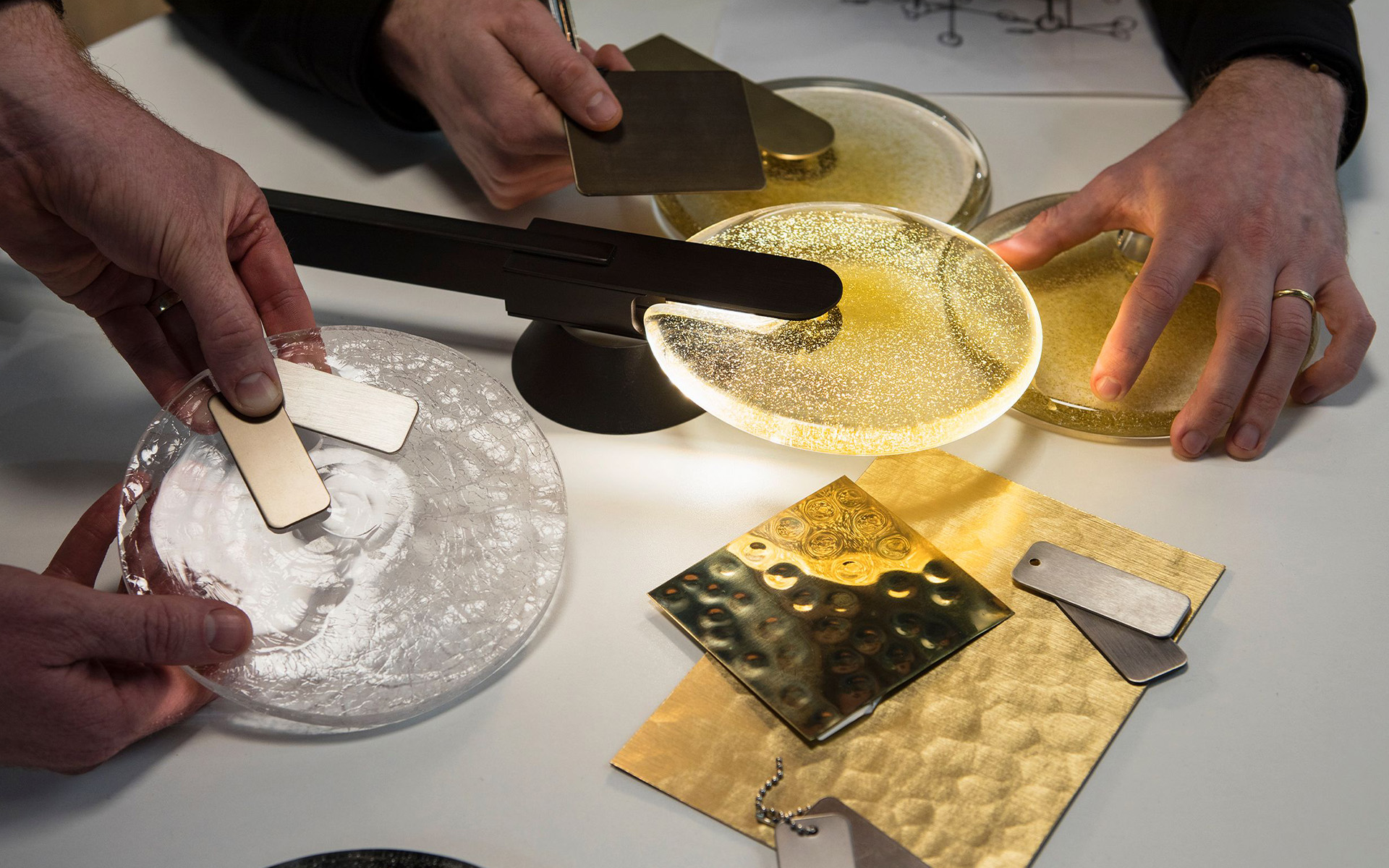
Light is intangible, sometimes unpredictable. The only way to fully realise the design intention is to build it, so we test out our ideas through 3D-printed models or scaled mock-ups.
For some commissions, this is a linear process; for others, it is more fluid and takes us in a direction we didn’t expect. A subtle adjustment with pigment in a glass component or a change in finish can transform how that material interacts with light. Recent advances in LED technology and miniaturisation also allow us to integrate light sources into an artwork, so they almost disappear. When we play around with form and components in this way, we can deliver a more elevated composition, defined by the interplay of light and materials.
Making
It is a human impulse to want to make beautiful things.
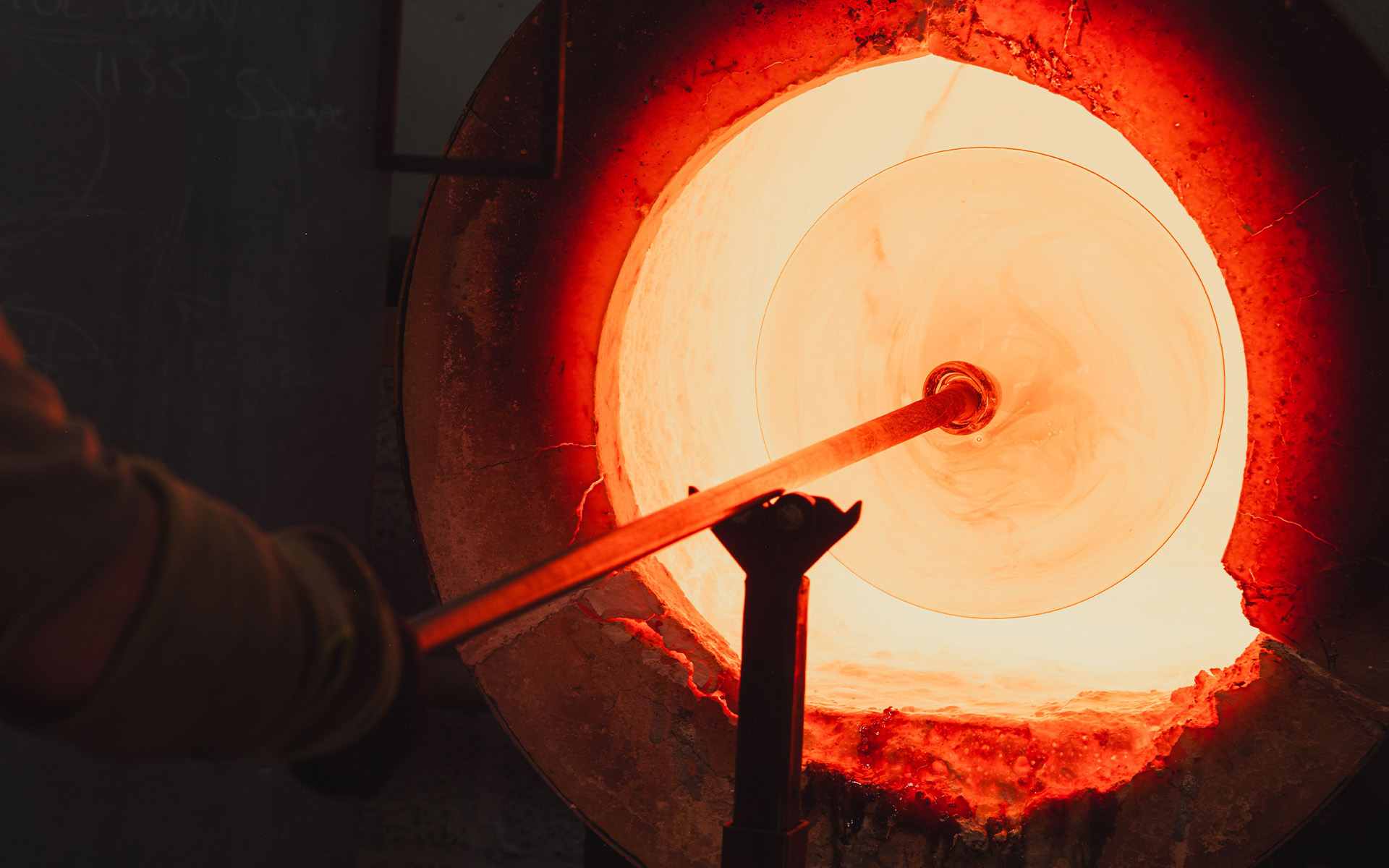
In the workshop, where we have the privilege of working alongside our talented craftsmanship partners, we experience first-hand the value of handcrafted techniques and timeless materials. Artisanal skills such as glassblowing, woodturning and ceramic forming have stood the test of time for good reason. They allow each concept to be realised in a unique way.
These traditional methods remain a constant source of inspiration, encouraging the continuous development and refinement of our practice. It is here, in the act of making, that the process comes full circle: the idea becomes something tangible, and the intention to create a piece that sparks joy is finally realised.